Applications
Roll Forming Machine Applications
Roll forming lines are chosen by the profile they produce and by the industry that buys it. The six applications below name the profiles involved in each, the line family that produces them, and the points that decide the configuration before a price is quoted.
If you already know the section but not the machine, start from the profile table at the end of the page. If you are still defining the product, start from the application closest to your project.
- Application areas 5 industries
- Profile families 11 families
- Sheet thickness 0.45–5.0 mm
- Countries served 80+
Before you compare machines
Four Questions That Decide the Line
Two buyers can ask for "a roof panel machine" and need completely different equipment. These four answers are what turn an application into a specification.
Profile geometry
Developed width, rib height, bend radii and the number of bends decide the roll set, the shaft length and the station count before anything else is quoted.
Material and coating
Prepainted, galvanized, galvalume, stainless or aluminium — the grade and the thickness range set the drive power, the roll finish and the way strip is handled between stands.
Output and automation
Metres per minute, cut length, punching in line and how the finished profile leaves the line. Output per shift is what the quotation is built around.
Site and supply conditions
Voltage and frequency, floor space, coil handling, local standards and the spare parts you want to keep on the shelf.
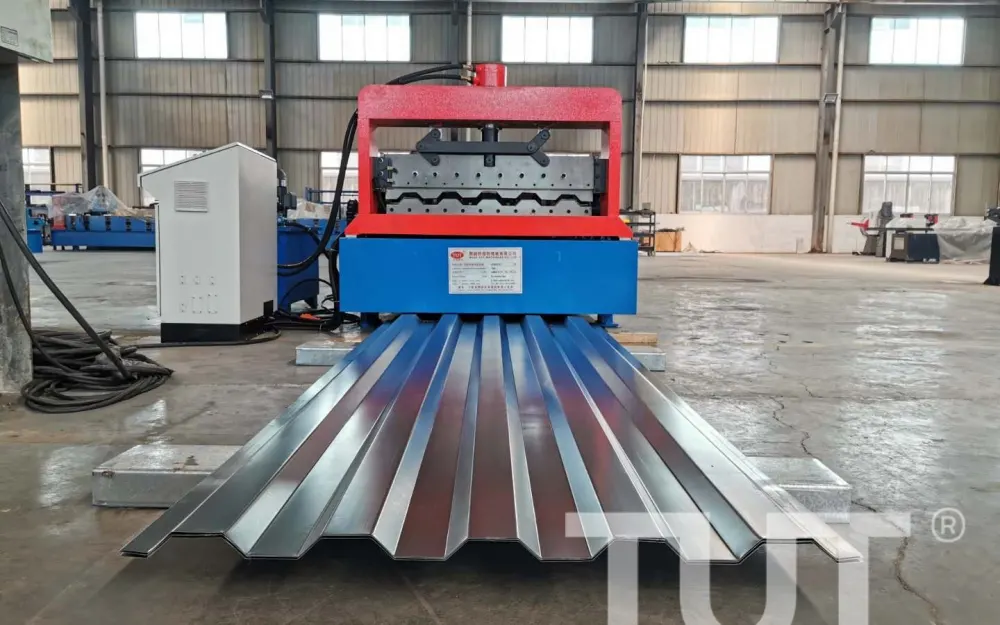
Roll Forming Lines for Roofing, Decking and Steel Framing
A steel building package is assembled from profiles that all come off a roll forming line — the roof and wall panels, the floor deck, the purlins that carry them and the gutters that drain them.
Cladding producers usually start with a roof panel line: corrugated or trapezoidal sheet in 0.5–0.8 mm prepainted coil. Where the same plant sells into several markets, a double layer line runs a second profile on the same base frame, with a switching device selecting the active forming train. Panels are cut to length per order, so the shear and the run-out table are sized around the longest sheet you expect to sell.
Structural work pulls in the rest of the package. Purlins carry the roof and wall panels, floor deck carries the concrete slab, and both are bought from the same supplier as the cladding when a contractor wants one delivery. A purlin line and a deck line can share coil handling with the roof line, and the C/Z changeover is a roll set change rather than a second machine.
Lines built for this application
-
3 models
Roof panel lines
Corrugated, trapezoidal and standing seam panels, single or double layer build.
-
1 model
Floor deck lines
Heavy-gauge composite deck profiles with embossing and end closing.
-
2 models
Purlin lines
C, Z and CZ sections with in-line punching and flange forming.
-
1 model
Gutter lines
Downspout and box gutter sections with seam lock and crimping.
- Coil width drives everything — 1000, 1200 and 1250 mm are the common starting points for panel lines.
- Panels are cut at the building site as often as in the plant, so cut-length repeatability matters more than raw line speed.
- Purlins need punching for the bolt pattern; that station belongs in the line, not in a second operation.
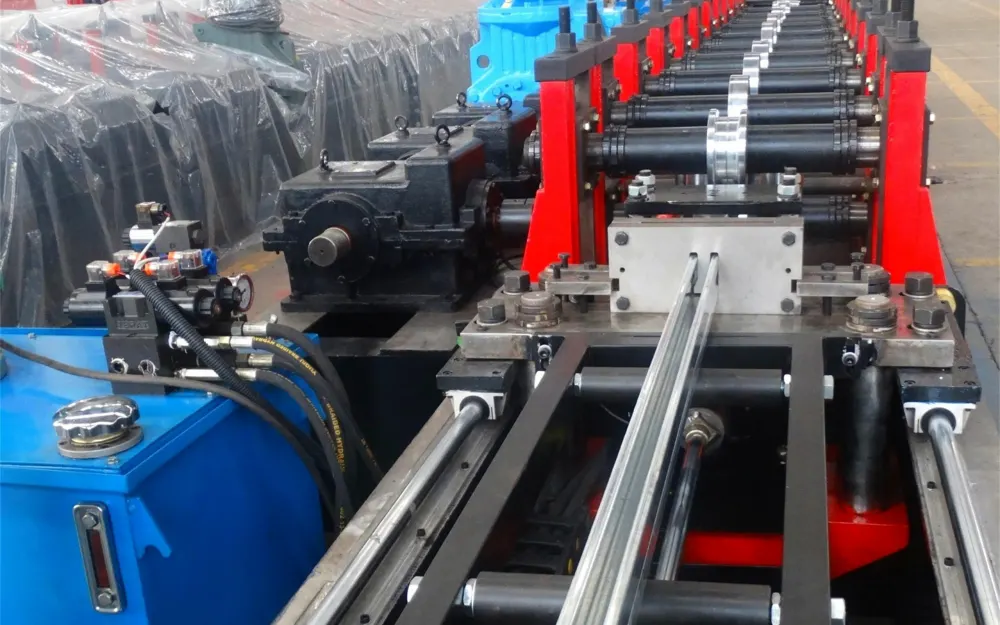
Roll Forming Lines for Solar Mounting and Strut Channel
PV arrays, cable management and support frames are held together by cold formed channels. The section looks simple; the hole pattern, the edge condition and the coating decide whether the system assembles cleanly on site.
Most mounting systems use a 41×41 mm strut channel with a slotted or plain back, plus rails and splice sections in matching gauges. A strut channel line forms the section, punches the slot pattern in line and cuts to fixed lengths, so the installer receives a channel that already carries the holes the bracket needs.
Pre-galvanized coil is the usual input because it keeps the cut edges protected. Where a project specifies galvanizing after forming, the tooling finish and the handling between stations are adjusted to avoid marking the zinc. Slotted holes, weld nuts and joining sections usually run on the same line with a different punch set, which keeps one coil and one operator for the whole range.
Lines built for this application
-
1 model
Strut channel lines
Forming, in-line slot punching and cutting for 41×41 and 41×21 channel.
-
3 models
Custom rail profiles
Non-standard rail and bracket sections engineered from the mounting drawing.
- Hole pitch and slot length come from the bracket system, not the machine — confirm them before tooling is cut.
- Pre-galvanized coil protects cut edges; galvanizing after forming needs a different handling layout.
- Channel straightness matters more than usual: a bowed channel will not accept a nut through the slot.
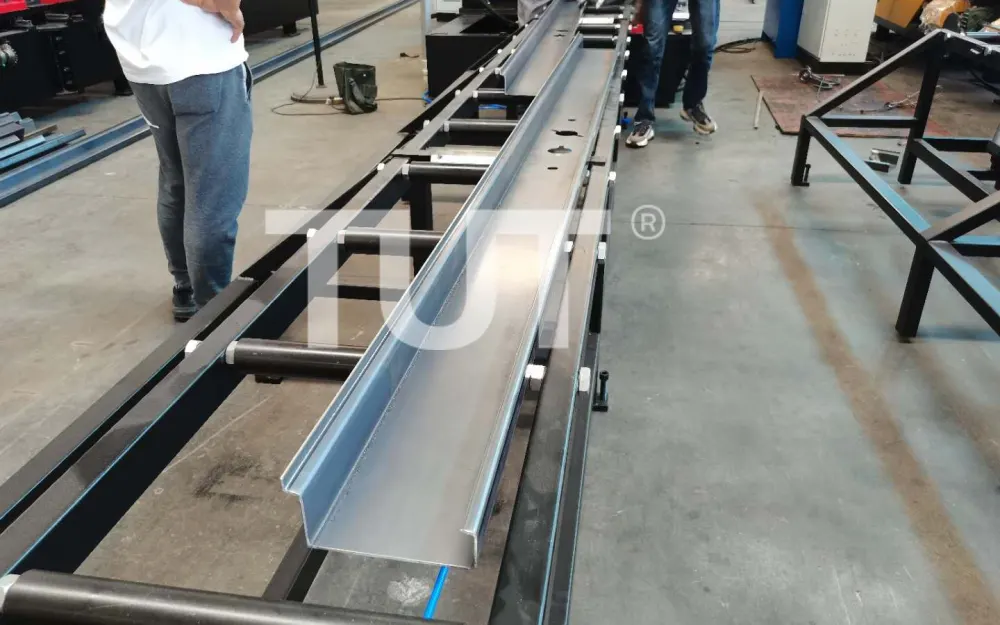
Roll Forming Lines for Highway Guardrail and Road Safety Profiles
Guardrail is formed from heavy gauge galvanized steel and has to meet a published standard. The profile is dictated by the standard; the line is dictated by the gauge and the coating.
A W-beam line runs 2.5–4.0 mm steel through a long forming train, punches the splice holes and cuts the beam to the lengths the project schedules. Thrie-beam, C-posts and sigma posts work on the same principle with a different roll set. Because the beam is galvanized after forming, the tooling has to handle the heavier strip without marking the surface, and the cut end has to stay square enough for the splice to sit flat.
Projects are usually specified to AASHTO M180 or EN 1317, and the purchaser asks for a section that matches the drawing in the tender document. Send the standard, the section drawing and the lengths you need, and we will confirm station count, punch pattern and line speed. Infrastructure profiles outside the standard range go through custom engineering.
Lines built for this application
-
Built to order
Guardrail lines
W-beam and corrugated beam sections, punched for splice bolts and cut to length.
-
3 models
Custom infrastructure profiles
Non-standard posts, transitions and barrier sections built to the tender drawing.
- Standard compliance is checked on the finished section — tell us which standard the project cites.
- Galvanizing after forming changes the handling layout and the tooling finish.
- Splice holes are punched in line; drilling afterwards adds a second operation and a second tolerance stack.
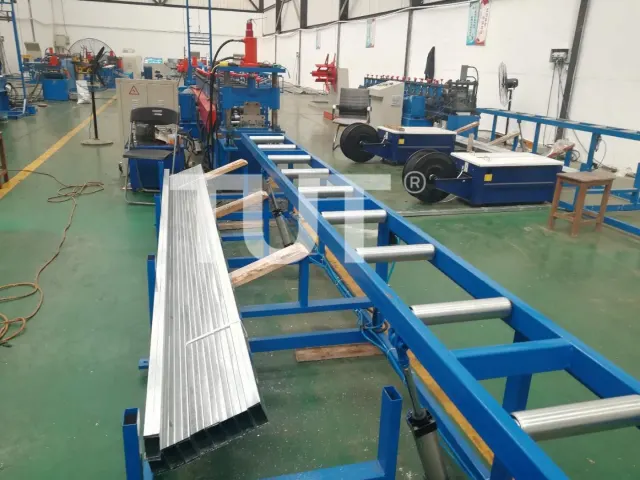
Roll Forming Lines for Drywall Studs, Tracks and Door Frames
Partition and ceiling systems consume enormous volumes of light gauge profile. These lines run fast, cut on the fly and are usually specified by output per shift rather than by station count.
A stud and track line forms C-stud and U-track from 0.45–0.8 mm galvanized coil, punches service holes and cuts to fixed lengths at up to 15 m/min. Output is bundled and strapped at the run-out, because the next stop for the profile is a pallet, not a paint line.
Steel door frames take a different route. A door frame line forms the frame section, prepares hinge and lock positions, and bends the profile into a frame. Ceiling furring channels, corner beads and architrave profiles can run on a stud and track line with a different roll set. Where one plant supplies both, coil handling and the control platform are usually shared.
Lines built for this application
-
1 model
Stud & track lines
C-stud and U-track, 0.45–0.8 mm, punched and cut to length at up to 15 m/min.
-
1 model
Door frame lines
Frame sections with hinge and lock preparation, formed and bent into a frame.
- Speed is set by the shear and the run-out, not the forming bed — ask for output per shift, not only m/min.
- Service holes and dimples are punched in line; check the pattern against the partition system you sell.
- Bundling and strapping at the run-out is part of the line, otherwise the profiles arrive bent.
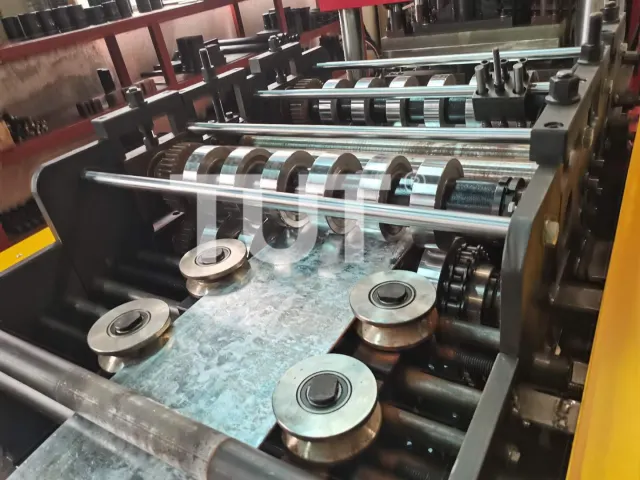
Roll Forming Lines for Cable Tray, Trunking and Panel Profiles
Electrical installation work needs perforated cable tray, trunking, strut and panel frame sections — all light gauge, all hole-heavy, all produced in long runs and cut to stock lengths.
A cable tray line forms the tray body with a rolled edge, punches the perforation pattern in line and cuts to length. The edge roll is what gives the tray its stiffness: a sharper edge saves material but leaves a hand-cut hazard on site, so the radius is set by the market the tray is sold into.
Ladder tray, trunking and panel frame sections follow the same logic with a different roll set. Thin wall T-section tube for sliding gate track runs on a laser welding tube line, where the seam is welded rather than locked. Where a plant also produces electrical enclosures, the GGD panel frame section is another custom profile we have built lines for.
Lines built for this application
-
2 models
Cable tray lines
Perforated tray bodies with a rolled edge, punched and cut in line.
-
1 model
Laser welding tube lines
Closed T-section tube with a welded seam for gate track and framing.
-
3 models
Custom enclosure profiles
Panel frame and enclosure sections built to the drawing.
- Perforation density sets the punch station count — and line speed — more than the forming bed does.
- Run-out length decides whether tray is cut to stock length or cut to order.
- Welded tube needs a different architecture: forming, welding, sizing and straightening in one pass.
Profile reference
Which Line Produces Which Profile
Twelve profile families cover the applications above. Use this table when you already know the section but not the machine.
Swipe the table sideways to see the line column →
| Profile family | Where it is used | Line |
|---|---|---|
| Corrugated & trapezoidal roof sheet | Roof and wall cladding, site buildings, container roofs | Roof Panel Roll Forming Machine |
| Standing seam panel | Architectural roofs, low-slope commercial buildings | Roof Panel Roll Forming Machine |
| Composite floor deck | Multi-storey steel buildings, mezzanine floors | Deck Floor Roll Forming Machine |
| C / Z / CZ purlin | Secondary framing for steel structures | Purlin Roll Forming Machine |
| Downspout gutter | Rainwater drainage on industrial roofs | Gutter Roll Forming Machine |
| Drywall stud & track | Partitions, ceilings, shaft walls | Drywall Stud and Track Roll Forming Machine |
| Solar strut channel | PV mounting, cable support, seismic bracing | Solar Strut Channel Roll Forming Machine |
| Highway guardrail | Road safety barriers, infrastructure projects | Highway Guardrail Roll Forming Machine |
| Cable tray & trunking | Cable management in buildings and plants | Cable Tray Roll Forming Machine |
| Steel door frame | Doors, frames and interior fit-out | Door Frame Roll Forming Machine |
| Welded T-section tube | Sliding gate track, fencing, light framing | Laser Welding Tube Roll Forming Machine |
Profile names follow common market usage. If your section is not listed, send the drawing — most of these families were built from a customer drawing in the first place.
FAQ
Questions Buyers Ask Before Choosing a Line
Answers come from quotation discussions across the five applications above. If your question is not here, ask it directly and an engineer will answer.
Which roll forming machine do I need for my profile?
Start from the section drawing rather than from a machine category. Developed width, material and thickness range, the tolerance that matters most, and your target output per shift decide the station count, shaft diameter, drive power and cutting method. Send those four items and we will name the line configuration instead of a catalogue number.
Can one line produce more than one profile?
Yes, in two ways. A double layer line carries two forming trains on one base frame and switches between them, which is common for corrugated and trapezoidal roof panels. A single layer line accepts interchangeable roll sets, so a stud and track line can also run furring channel. Changeover is a roll set change plus a punch die change, and we state the changeover time in the quotation.
What material thickness can your lines form?
Light gauge profiles run from 0.45 mm to about 0.8 mm, structural sections and purlins from 1.5 mm to 5.0 mm. The practical range for a specific line is narrower than that and is set by shaft diameter, station count and motor rating, so the drawing and the gauge range are quoted together.
Can the line be built for our voltage and local standards?
Yes. 380 V / 50 Hz is the standard build; 415 V, 440 V and 60 Hz systems are available, with motors, contactors and the control cabinet matched to the destination market before shipment. Where a profile has to meet a published standard, such as AASHTO M180 or EN 1317 for guardrail, the section is quoted against that standard.
How do I check the line will meet my output target?
Output per shift is line speed multiplied by effective running time, and effective running time is shortened by coil changes, cut cycles and changeovers. A line quoted at 20 m/min does not deliver 20 m/min for a full shift. Tell us the profile length, the output you need per shift and how many sizes you change in a week; the configuration follows from those three numbers.
Do you build lines for a profile that does not exist yet?
Yes. Custom profiles go through roll design first: we check the developed width, the bend radii and the material grade, then issue roller drawings for approval before tooling is cut. This is the normal route for proprietary enclosure, cable support and infrastructure sections, and it is handled as a project rather than as a catalogue order.
Next step
Tell us the profile and the application
Send the section drawing, material and thickness, target output per shift and where the line will be installed. You will get a line configuration, tooling scope and delivery schedule — usually within one working day.
Or start from a profile family on the product overview.