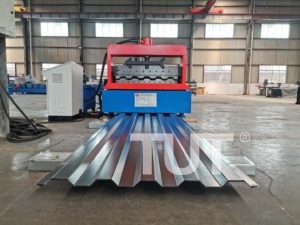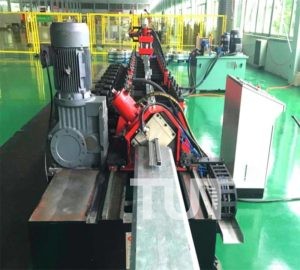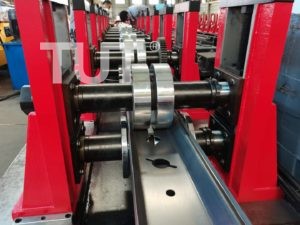
Truck Beam Roll Forming Machine
Truck beam roll forming machines built to your section drawing, with in-line punching and a section-shaped cut for heavy-gauge chassis beams.
View DetailsRoll forming lines
Lines engineered from a profile drawing rather than a catalogue — decoiler, forming, punching, cutting and stacking matched to a section nobody stocks.
Truck beam roll forming machines built to your section drawing, with in-line punching and a section-shaped cut for heavy-gauge chassis beams.
View DetailsContainer Roof Panel Roll Forming Machine is used to produce shipping container roof panels, with the thickness range from 1-2mm, wave height 20-40mm.
View DetailsGGD Electrical Distribution Panel Roll Forming Machine is designed to produce GGD Electrical Distribution Panel which is is used for power plants, substations.
View DetailsTechnical overview
A custom line is quoted from the section, not from a machine model. Four inputs decide 80 percent of the design: developed width, thickness and grade, the tolerance that matters most, and the output you need per shift.
The developed width sets coil width and shaft length. Thickness and yield strength set station count and motor rating — a 0.5 mm trim profile and a 5 mm structural section are not the same machine. The critical tolerance tells us where to put the gauge and whether a straightener is needed. Output per shift decides between a simple post-cut line and a flying cut with an accumulator.
Typical scope runs from a 12-station line for a small trim profile to a fully automated line with decoiler, straightener, servo feed, 3-side punching, flying cut and stacker. Drawings are issued for approval before tooling is cut, and first-off samples are run before shipment. Existing examples of non-standard work include custom cable tray and laser welded tube lines.
Figures are typical for this category. Final values follow the profile drawing and material grade.
Discuss your specificationApplications
The same machine serves different industries depending on the profile, coating and output. Start from the application closest to your project.
FAQ
Answers come from real quotation discussions. If your question is not here, ask it directly and an engineer will answer.
A profile drawing with dimensions and tolerances, the material and thickness range, and the output per shift you are aiming for. A physical sample is better than a drawing if the profile already exists.
45–90 days from approved drawing, depending on station count and whether a punch die is included. Roll design and machining run in parallel with frame fabrication.
Yes. We regularly make tooling and spare parts to an existing drawing, including copying an imported line. Send the drawing or the worn part and we will confirm material and tolerance.
Yes. First-off samples are formed and measured against the drawing, and the inspection report ships with the machine. For prepainted or coated material we also run a surface check at the same time.
Next step
Send the profile drawing, material thickness and target output. You will get a line configuration, tooling scope and delivery schedule — usually within one working day.
Or compare non-standard builds on the custom roll forming page.