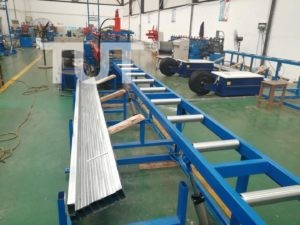
Drywall Steel Stud Roll Forming Machine
Drywall Steel Stud Roll Forming Machine is designed to produce drywall stud framing which is fundamental to Industrial and commercial construction.
View DetailsRoll forming lines
Lines for C-stud and U-track drywall profiles in 0.45–0.8 mm galvanised coil — forming at 0–15 m/min with in-line punching for service holes and a flying cut that keeps pace with the strip.
Drywall Steel Stud Roll Forming Machine is designed to produce drywall stud framing which is fundamental to Industrial and commercial construction.
View DetailsTechnical overview
Stud and track is a commodity product sold by the tonne, so the margin sits in output per hour. On these lines the limit is rarely the forming speed — it is how fast the punching station can clear a dense service-hole pattern without stopping the strip.
A typical line runs 0–15 m/min with 14 stations on 75 mm shafts. The punching press sits between the last forming pass and the cut-off, punching service holes, dimples and screw marks in one stroke; punch tooling is quick change so a profile change does not need a new press. The flying cut-off travels with the strip and returns on a servo axis, which is what allows the line to run continuously instead of stop-start.
Because the profiles are thin, coil handling matters as much as forming. A hydraulic decoiler with a coil car and a loop pit keeps tension stable through the run, and a straightener removes coil set before the first pass. Many buyers run stud and track on the same line with a second set of rolls — the custom roll forming page covers multi-profile builds, and building and construction lists where these profiles are used.
Figures are typical for this category. Final values follow the profile drawing and material grade.
Discuss your specificationApplications
The same machine serves different industries depending on the profile, coating and output. Start from the application closest to your project.
FAQ
Answers come from real quotation discussions. If your question is not here, ask it directly and an engineer will answer.
The forming speed is 0–15 m/min. Effective output per shift is set by the punching station rather than by the forming speed: a dense service-hole layout adds a press cycle to every cut length, and that cycle — not the roll speed — decides how many metres leave the line in an hour.
Yes, with a second roll set and a changeover of the punching tools. Changeover takes roughly 4–8 hours with two technicians. Buyers who need high volumes of both usually take two dedicated lines instead.
The standard decoiler accepts 508 mm coil ID with an optional 610 mm mandrel. Outside diameter up to 1500 mm and coil weight up to 3 t on the standard build.
The flying cut-off uses a guillotine die with a shear angle matched to the profile, which holds the cut within ±1 mm of square. That is the tolerance most export buyers ask for on bundled stud.
Next step
Send the profile drawing, material thickness and target output. You will get a line configuration, tooling scope and delivery schedule — usually within one working day.
Or compare non-standard builds on the custom roll forming page.