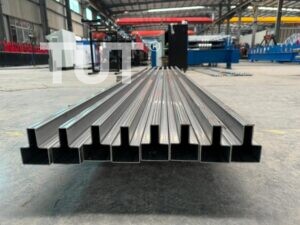
Laser Welding T-shaped Square Tube Roll Forming Machine for Sliding Gate Track
Laser Welding T-shaped Square Tube Roll Forming Machine is specially designed to produce sliding gate track for garage sliding gate.
View DetailsRoll forming lines
Forming and laser welding in one pass — T-section square tube and similar profiles, with a narrow heat affected zone and a seam that closes flush on the visible face.
Laser Welding T-shaped Square Tube Roll Forming Machine is specially designed to produce sliding gate track for garage sliding gate.
View DetailsTechnical overview
A high frequency welder leaves a visible bead and a heat affected zone that spreads several times the wall thickness. A fibre laser delivers the same weld energy into a narrower band, so thin wall and pre-coated tube come off the line cleaner.
The line forms strip into shape through a series of forming and fin passes, welds the seam with a laser head, then sizes the section through Turks head stands. A scarfing tool removes the outside bead where a flush finish is required; the inside bead stays unless an internal scarfing unit is specified. On our standard build the line runs 22 stations on 80 mm shafts with a 37 kW main motor, at 0–10 m/min.
Laser welding is chosen where the tube is used for a visible application such as sliding gate track, furniture frames or door profiles, and where the weld line must not show through coating. The weld pool is small, so heat distortion stays low compared with HF welding on the same section. Fume extraction and laser safety guarding are part of the standard scope. See custom roll forming for shaped sections outside this family.
Figures are typical for this category. Final values follow the profile drawing and material grade.
Discuss your specificationApplications
The same machine serves different industries depending on the profile, coating and output. Start from the application closest to your project.
FAQ
Answers come from real quotation discussions. If your question is not here, ask it directly and an engineer will answer.
Laser power is matched to the wall thickness and the line speed you need, and it is selected at order stage rather than fixed by the machine frame. Send the section, the wall thickness range and the metres per shift you must hit, and the welding head is sized for that combination.
Only with the optional internal scarfing unit, which adds a mandrel and a rod inside the tube. Most visible applications only need the outside bead removed.
Laser welding of galvanized strip produces zinc vapour at the seam, so the line needs fume extraction at the weld point and, on heavier coatings, a seam preparation step. We configure the extraction as part of the weld head enclosure.
Straightness is set by the sizing stands and checked on the finished section. It is confirmed against the tolerance on your own profile drawing at tooling design; tighter figures need an additional straightener after the sizing stands.
Next step
Send the profile drawing, material thickness and target output. You will get a line configuration, tooling scope and delivery schedule — usually within one working day.
Or compare non-standard builds on the custom roll forming page.