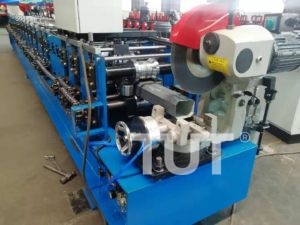
Downspout Gutter Roll Forming Machine
Downspout Gutter Roll Forming Machine is designed to produce rain downspout gutter which are vertical pipes that are used to divert rain water away…
View DetailsRoll forming lines
Lines for seamless rain gutter and downspout profiles in aluminium, copper and prepainted steel, including the bending and crimping stations that turn a flat strip into a finished run.
Downspout Gutter Roll Forming Machine is designed to produce rain downspout gutter which are vertical pipes that are used to divert rain water away…
View DetailsTechnical overview
A gutter profile is a folded open section, so the line has to control the lip, the bead and the hanger flange at the same time. Small errors in the bead show up as leaks after the first season.
The forming train runs 22 stations on 70 mm shafts and finishes with a curling station that rolls the front bead and returns the back flange. Material choice drives the tooling: aluminium needs polished rollers and lower pressure to avoid galling, copper needs dedicated rollers because it work hardens, and prepainted steel needs a protective film or nylon guides at every contact point.
Downspout lines add a tube forming section, a seam lock and, on rectangular spout, a bending station. Where gutters are sold as finished runs, the line is paired with a run-out table and a crimping station. See roof panel lines for the sheet that usually goes with this profile, or building applications for where they are installed.
Figures are typical for this category. Final values follow the profile drawing and material grade.
Discuss your specificationApplications
The same machine serves different industries depending on the profile, coating and output. Start from the application closest to your project.
FAQ
Answers come from real quotation discussions. If your question is not here, ask it directly and an engineer will answer.
Yes, but with different roller sets. Copper work hardens quickly, so it needs dedicated polished rollers and reduced forming pressure. Aluminium runs on the same frame with a pressure reset. Tell us the material mix at enquiry stage.
Closed profiles are limited by coil size, not by the machine. With a 650 mm coil you can form runs limited only by handling length; in practice most buyers form 6–12 m runs and join on site with a sealant or a crimped connector.
Standard builds cover K-style with a 25–35 mm front bead, box gutter with a flat return and half round with a rolled edge. Hanger flange depth is set at tooling design and cannot be changed afterwards.
Prepainted coil runs with either a protective film or nylon guide inserts at the entry, and rollers are chrome plated with rounded edges. Aluminium uses a lubricant film that is wiped at the run-out table.
Next step
Send the profile drawing, material thickness and target output. You will get a line configuration, tooling scope and delivery schedule — usually within one working day.
Or compare non-standard builds on the custom roll forming page.