After-sales service
Roll Forming Machine Installation, Training & After-Sales Service
A line is not finished when it leaves Wuxi. It is finished when it holds tolerance in your plant, on your coil, at the output you planned for. This page sets out what happens between the order and that point: the drawings you receive before shipment, who installs the machine, what training your team gets, and how a part for a machine built years ago is still matched to it.
- Lines supported 80+ countries
- Commissioning On site or by video call
- Training Operators & maintenance
- Spare parts Matched to your drawings
From order to production
Support Is Planned at Quotation Stage, Not After Delivery
We support every machine from installation to end of life. Before delivery we provide foundation drawings and layout planning so the line fits your building and material flow.
After arrival, our engineers handle on-site installation and commissioning, train your operators on changeover and daily maintenance, and stay reachable for PLC, hydraulic and forming quality issues.
Spare parts — rollers, shafts, bearings, cutting blades, hydraulic and electrical components — are supplied for the full service life of the line.
Every machine is built to one section, so the support is not a general programme — it follows the drawings of your profile. That is what makes a part orderable years later and a second line match the first.
- 01 Before the machine ships Roll design, foundation drawing, electrical build and a test run on material.
- 02 Installation and commissioning An engineer on site, or scheduled video calls for a repeat line.
- 03 Training your team On the line, with your material, ending in a written settings record.
- 04 Spares and support in production Parts matched from the archive drawings; faults answered by the same engineers.
Phase 01 — Pre-delivery
Before the Machine Ships
Four things are settled in Wuxi while the machine is still on our floor. Each one is what stops a commissioning visit turning into a second project on site.
-
01
The roll set is designed from your section
Developed width, bend sequence and the tolerance that matters on your product are settled before a roller is turned. A roll set is not picked from a catalogue and adjusted on site afterwards; the profile drawing is what the tooling is cut to.
-
02
Foundation and layout drawing
You receive a foundation drawing and a layout plan sized to the floor you actually have, including coil loading, run-out length and the clearance a crane or forklift needs. Checking this before crates are booked is cheaper than moving a pit after the machine lands.
-
03
Electrical build for your supply
Drive, inverter and control panel are built to the plant supply — 380 V/50 Hz, 415 V/50 Hz or 440 V/60 Hz, three phase — with the panel labelled in English. Lines in our project list run on all three, so this is confirmed at order stage rather than assumed.
-
04
Test run before the line is dismantled
The line is assembled and run on material in Wuxi before it is broken down for packing: stations, punching, cut-off length and line speed are checked and the dimensions recorded. Customers who can attend do; those who cannot receive the video and the measurement sheet.
Phase 02 — Installation & commissioning
Two Ways to Commission a Line
An engineer on site is the default for a first machine. Video commissioning exists for repeat lines and plants where a visa and a flight would cost more than the installation is worth — and it only works under conditions we state up front.
Recommended for a first line
An engineer on site
For most first machines, and for any line with in-line punching or a flying cut, a commissioning engineer travels to the plant.
- Mechanical assembly and alignment of each module, with the line levelled to the foundation drawing.
- Trial coils run on your material, with section dimensions measured and corrected until the profile holds tolerance.
- Punching and cut-off set to your hole pattern and cut length, then written down.
- Operators trained during commissioning rather than after it, on the line as it is being set.
Travel, visa and accommodation are quoted with the machine or as a separate line item, so the cost is visible before the order rather than after it.
For repeat lines and remote plants
Guided by video call
When the machine repeats one you already run, or travel takes longer than the installation, commissioning is handled on scheduled calls.
- A step-by-step assembly sequence by video, with a fixed call slot each working day while the line goes together.
- Alignment checked against readings your team takes — level, shaft parallelism, roll gap — compared with the commissioned values.
- First coils run on camera, with section measurements and photos sent back for checking before production starts.
- The same settings record as an on-site commissioning, so the line still has a documented baseline.
This needs a phone or tablet with a stable connection on the shop floor and someone who can take measurements. If neither is available, book the on-site visit.
Phase 03 — Training
Training Ends With a Written Record
Training happens on your line, with your material, for the three groups who will actually touch it. Handing over a manual is not training; the test is whether the line still runs correctly after the people who commissioned it have gone home.
Operators
The people who run the line every shift.
- Coil loading, strip threading and the checks before the first pass.
- Cut length, quantity and batch setting on the HMI.
- Alarm codes, and what to look at first before calling anyone.
- Changeover between profiles where the line is built to allow it.
Maintenance
The people who keep it running.
- Lubrication points and the interval that actually matters.
- Roll gap, shaft, bearing and drive chain checks.
- Blade and punch replacement, including what to torque and what to check after.
- Hydraulic pressure, seal and filter checks.
- Reading a part number off the drawing instead of describing the part.
Supervisors and quality
The people who decide whether the product is good.
- What moves a section out of tolerance: coil width, yield strength, springback.
- Measuring a section the same way every shift, so numbers are comparable.
- When to stop the line and call, rather than adjust until it looks right.
Training ends with a written handover: the settings the line was commissioned at, the checks that matter and the part numbers for the wear items. A new operator can then start from those numbers instead of from trial and error — which is also what makes a replacement team trainable years later.
Phase 04 — In production
When Something Stops the Line
Production questions go to the engineers who built the machine, not to a distributor. Find your situation below: it tells you what to send and what you get back, which is usually faster than describing the problem from the beginning.
| Situation | What to send | What comes back |
|---|---|---|
| Line down, production stopped | Call or message the number below rather than waiting for an email. Have the machine model, the alarm code and a photo of the HMI screen ready. | A phone or video walk-through during China office hours, ahead of other work — a stopped line is treated as the urgent case it is. |
| Section drifting out of tolerance | A photo of the section with measurements, the coil specification, and the shift it started on. | A comparison against the settings the line was commissioned at, and the adjustment to make — usually within one working day. |
| A part has failed | The machine model, a photo of the nameplate and a photo of the failed part. | Confirmation of what fits your build, and a quotation — usually within one working day. |
| A second line or a new profile | The new section drawing, and which machine it should match. | The original drawings and electrical records are pulled from the archive, so the new line matches the one already running — same section, same settings, same spare parts. |
If the line is down, call first
Monday to Saturday, 08:30–17:30 China time (GMT+8)
- Phone +86 189 3238 3779
- WhatsApp Same number
- Email coldrollforming@foxmail.com
Spare parts
Parts Made From Your Machine’s Drawings
Parts are matched from the drawings kept for each machine, not from a catalogue number that may have changed since the order was placed. Send the model and a photo of the nameplate and the part, and the drawing is pulled to confirm the match before anything is quoted.
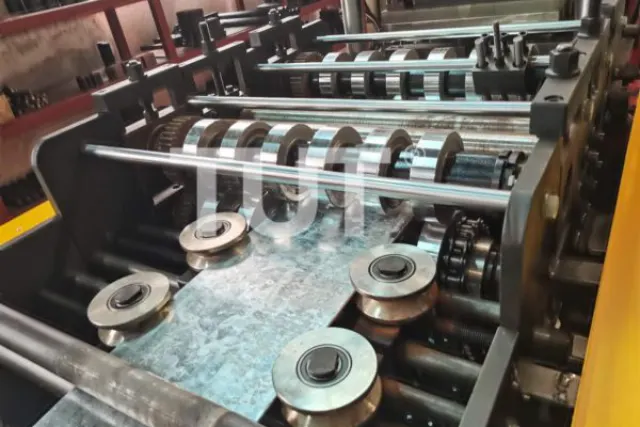
- Forming
-
- Roll sets, made to the original profile drawing
- Shafts, spacers and bearing housings
- Forming bearings and seals
- Cutting
-
- Cutting blades for post-cut and flying shears
- Blade holders and shear guides
- Punching
-
- Punches, dies and strippers
- Quick-change punch tooling for hole patterns
- Hydraulics & air
-
- Cylinders, seals and valve blocks
- Power unit parts, filters and gauges
- Electrical
-
- PLC modules, inverters and encoders
- Contactors, relays, sensors and HMI panels
What to put in the first kit. A first spare kit worth ordering with the machine: one set of cutting blades, one punch and die set, a full set of forming bearings, the hydraulic seals, one encoder and one PLC I/O module. These are the parts that stop a line for days rather than hours when a replacement has to be manufactured and shipped.
Ask for a parts quotationFAQ
Installation, Warranty and Spare Parts
The six questions buyers ask before a line is commissioned — including the ones about a machine we did not build.
What does the warranty cover, and for how long?
Every machine carries a 12-month warranty on the mechanical parts, with a 24-hour response on technical enquiries — including remote diagnosis of PLC, inverter and sensor faults. The written quotation states exactly which parts the warranty covers, so the period and the scope are agreed in writing rather than left to a general page. Wearing parts such as forming rollers, punch dies and cutting blades are supplied from stock as spares.
Do your engineers travel to our country for installation?
Yes. Engineers travel for mechanical installation, alignment, trial coils and operator training, and have commissioned lines in Asia, Europe, South America and Australia. Travel, visa and accommodation are quoted with the order so the total cost is known before it is placed. Where travel is impractical, commissioning is done on scheduled video calls instead.
Can you support a line we bought from another builder?
Partly. Roll sets and wear parts can be made where we can work from a drawing or a sample section, and forming and mechanical problems can be advised on. What we cannot do is match the electrical documentation of a control system built by someone else without its original schematics, so PLC faults on a third-party panel are best handled by the company that built it.
How long does a spare part take?
It depends on the part. Bearings, seals, blades and standard electrical items are usually the quickest. A complete roll set is a manufactured part and is scheduled like a small production order, because every roller is turned and hardened to your section. Send the model and the part details and the lead time is confirmed with the quotation.
Can you help with a PLC fault remotely?
Yes, and most PLC, inverter and sensor faults are diagnosed that way. The call needs someone standing at the cabinet: the alarm history on the HMI, the input and output status, and the wiring compared against the electrical manual supplied with the machine. If a module has failed, the replacement is identified from the same documentation.
Our original operators have left. Can you train new ones?
Yes. Refresher training can be arranged on site or by video call, starting from the settings record left at commissioning so the new team begins from the numbers the line was set up at. That record is the main reason it is written down at handover rather than handed over verbally.
Next step
Tell us the model, and what the line is doing
For a service or spare-part question, the machine model and a photo of the nameplate or the part is enough to start. If the line is still being specified, the 12 profile families and the delivered projects show what these machines are configured for.
Planning a visit instead? Book time at the workshop — the full address follows the confirmation.