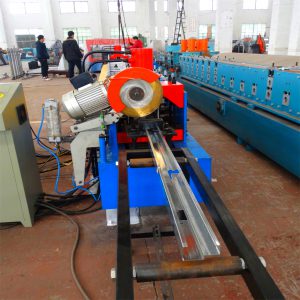
Door Frame Roll Forming Machine
Door Frame Roll Forming Machine is designed to produce steel metal door frame which are widely used for commercial, institutional, education, hospitality, etc.
View DetailsRoll forming lines
Lines for folded steel door frames in 1–2 mm galvanised coil, combining forming, hinge and lock punching, and hydraulic cutting in one pass.
Door Frame Roll Forming Machine is designed to produce steel metal door frame which are widely used for commercial, institutional, education, hospitality, etc.
View DetailsTechnical overview
A door frame is judged by whether the leaf hangs square. Hinge pocket position, striker position and anchor hole spacing all come off the punching station, so that is where line accuracy is really made.
The forming train folds the frame from 1–2 mm galvanised coil: a stop rebate, a web and a return leg, with an optional gasket groove. Because the section is stiff, the line uses 17 stations on 75 mm shafts and a hydraulic post-cut that shears the whole section in one stroke without collapsing the profile.
Punching is done either before forming on a separate press or in-line between the forming passes. In-line punching keeps hinge positions tied to the cut length, which removes the cumulative error a pre-punch setup develops. Frame width is adjustable on the web section for standard wall thicknesses. See drywall stud and track for the partition systems these frames sit in.
Figures are typical for this category. Final values follow the profile drawing and material grade.
Discuss your specificationApplications
The same machine serves different industries depending on the profile, coating and output. Start from the application closest to your project.
FAQ
Answers come from real quotation discussions. If your question is not here, ask it directly and an engineer will answer.
The web section is adjustable within a range for standard wall thicknesses, normally 75–200 mm. Changing the range itself needs a different tooling set, so fix the wall thickness range before tooling design.
With in-line servo punching the pocket position stays tied to the cut length, so it does not drift over a long run the way pre-punched coil does when it is fed into a separate forming line. The tolerance to quote is the one on your frame drawing — send it with the enquiry and it is confirmed at tooling design.
Yes. Rated frames usually need a deeper stop rebate and additional anchor holes, both of which are tooling details rather than machine changes. Provide the frame drawing with the rating requirement.
At 0–15 m/min a single shift runs well above what a manual folding cell can produce. Actual output is set by the punching pattern density rather than by the forming speed, so quote the hole layout when you ask for a capacity figure.
Next step
Send the profile drawing, material thickness and target output. You will get a line configuration, tooling scope and delivery schedule — usually within one working day.
Or compare non-standard builds on the custom roll forming page.