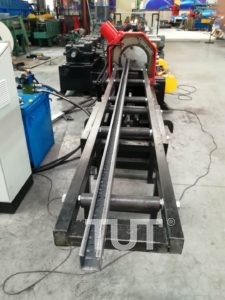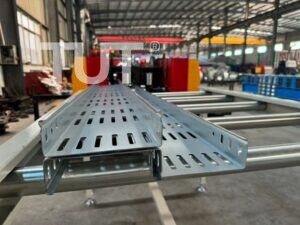
Fully Automatic Cable Tray Roll Forming Machine
Fully Automatic Cable Tray Roll Forming Machine is designed to produce perforated cable tray product, which is used to protect and support for the…
View DetailsRoll forming lines
Lines for perforated, ladder and solid cable tray in 1.2–2.5 mm galvanised steel, with adjustable tray width, in-line punching and a cut-off matched to the line speed.
Fully Automatic Cable Tray Roll Forming Machine is designed to produce perforated cable tray product, which is used to protect and support for the…
View DetailsCable tray roll forming machine designed to produce trays for power plants, substations, industrial enterprises and other power users.
View DetailsTechnical overview
Cable tray is sold in width steps and perforation patterns, so a tray line is really a flexible forming system. Width changeover and punch tooling change are what buyers compare, not top speed.
The line forms a U or box section from 1.2–2.5 mm galvanised coil, with return flanges and a rolled edge on the top. Width is set either by moving the side forming units on a linear guide or by a cassette system; the guide-rail approach is slower to change but holds width tolerance better on long runs.
Perforation is punched in-line before the last forming passes, so the pattern stays tied to the cut length. Ladder tray uses a separate punching module that removes the web between rungs. Cutting is a flying cut-off up to 1.2 mm and post-cut above it. See strut channel lines for the same family of open section profiles.
Figures are typical for this category. Final values follow the profile drawing and material grade.
Discuss your specificationApplications
The same machine serves different industries depending on the profile, coating and output. Start from the application closest to your project.
FAQ
Answers come from real quotation discussions. If your question is not here, ask it directly and an engineer will answer.
On a linear guide build, 30–60 minutes for two technicians including trial run. Cassette builds change in under 10 minutes but cost more and suit lines running many widths per shift.
Yes. A dedicated rung-removal module punches out the web between rungs at the pitch you specify. The module is a change part, so the same line can run perforated tray by swapping it out.
Standard builds reach 100 mm side height. Higher sides need longer shafts and a taller frame, which we quote as a separate configuration.
Galvanised coil across the 1.2–2.5 mm range runs normally. Heavier zinc coating increases roller wear, so rollers are chrome plated and the entry uses nylon guides to avoid scoring the coating.
Next step
Send the profile drawing, material thickness and target output. You will get a line configuration, tooling scope and delivery schedule — usually within one working day.
Or compare non-standard builds on the custom roll forming page.