Gutter Roll Forming Machine
Downspout Gutter Roll Forming Machine
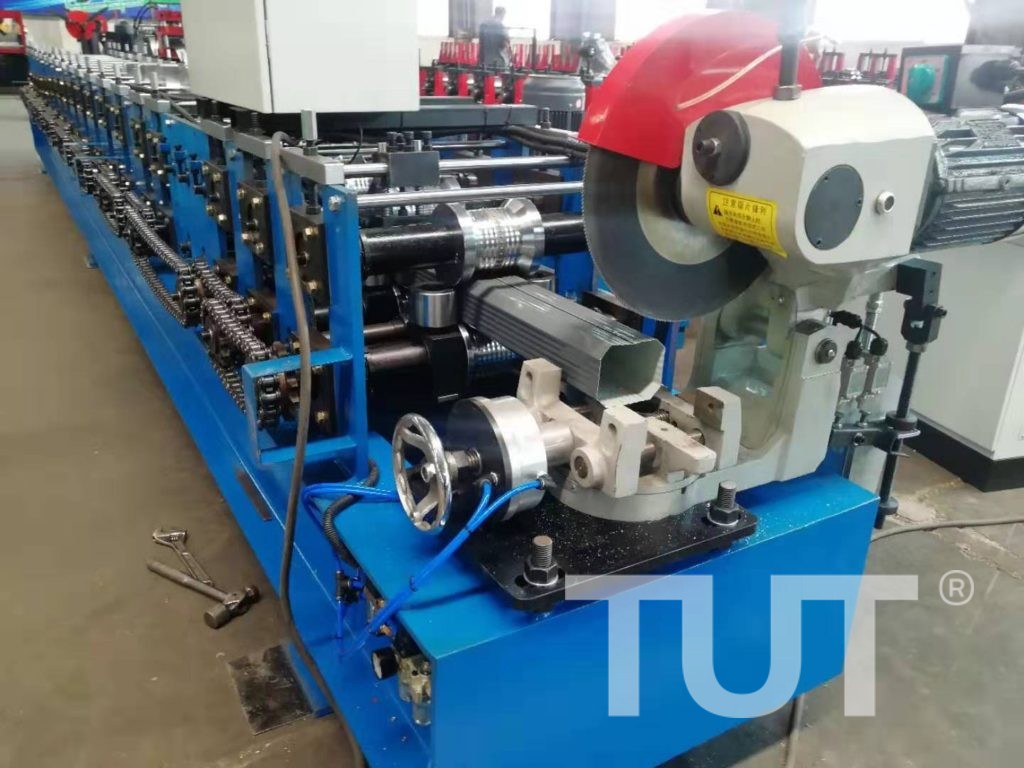
A downspout gutter line forming rain water pipes from 0.5–0.8 mm coil at up to 15 m/min. 22 stations close the seam progressively, so the round or rectangular downspout comes off the line already locked.
- Sheet thickness 0.5–0.8 mm
- Forming stations 22
- Forming speed 0–15 m/min
- Main motor 4 kW
Applications & material
What this machine is built to produce
The same frame serves different buyers depending on the profile and the material grade. Start from the application closest to your project, then check the section sizes below.
Where it is used
- Round and rectangular downspouts that carry rain water from roof gutter to drain.
- Roofing contractors who want downspouts in the same colour as the roof panel.
- Gutter and flashing workshops supplying building material merchants.
Suitable material
- Prepainted galvanised steel (PPGI)
- 0.5–0.8 mm
- Hot-dip galvanised steel
- 0.5–0.8 mm
- Galvalume
- 0.5–0.8 mm
- Copper and zinc (special build)
- 0.6–0.8 mm, hardened rolls
Target profiles
- Round downspout, φ80 / 100 / 120 mm
- Rectangular downspout, 60 × 80 mm to 80 × 100 mm
- Seam-locked tube with a folded joint
- Custom spout section from your drawing
Not on the list? The rolls are cut to a drawing — send yours and we will confirm feasibility.
Technical data
Downspout Gutter Roll Forming Machine specifications
Values below are for the standard build of this model. Thickness range, station count and motor rating are re-calculated when the profile or the steel grade changes.
Send your profile drawing| Parameter | Value |
|---|---|
| Sheet thickness | 0.5–0.8 mm |
| Forming stations | 22 |
| Forming speed | 0–15 m/min |
| Shaft diameter | φ70 mm, 45# steel |
| Roller material | 45# steel, chrome plated ≤0.05 mm |
| Main motor | 4 kW |
| Hydraulic station power | 3 kW |
| Cutting blade | Cr12MoV, HRC 56–58 |
| Control | PLC + touch screen |
Final values follow the profile drawing and material grade. Tolerance, power supply and line layout are confirmed on the approved drawing.
Working process
From coil to finished profile
The sequence below is the standard layout for this model. Stations are added or removed when the section needs more forming passes.
- 01 Decoiling Manual decoiler; narrow coil, light tension.
- 02 Feeding guide Entry guide aligned to the strip edge because the seam position is critical.
- 03 Main roll forming 22 stations curving the strip into a tube and closing the lock seam.
- 04 Cut to length Hydraulic post-cut, square to the tube axis.
- 05 Run-out table Short table with a catcher for round sections.
Main components
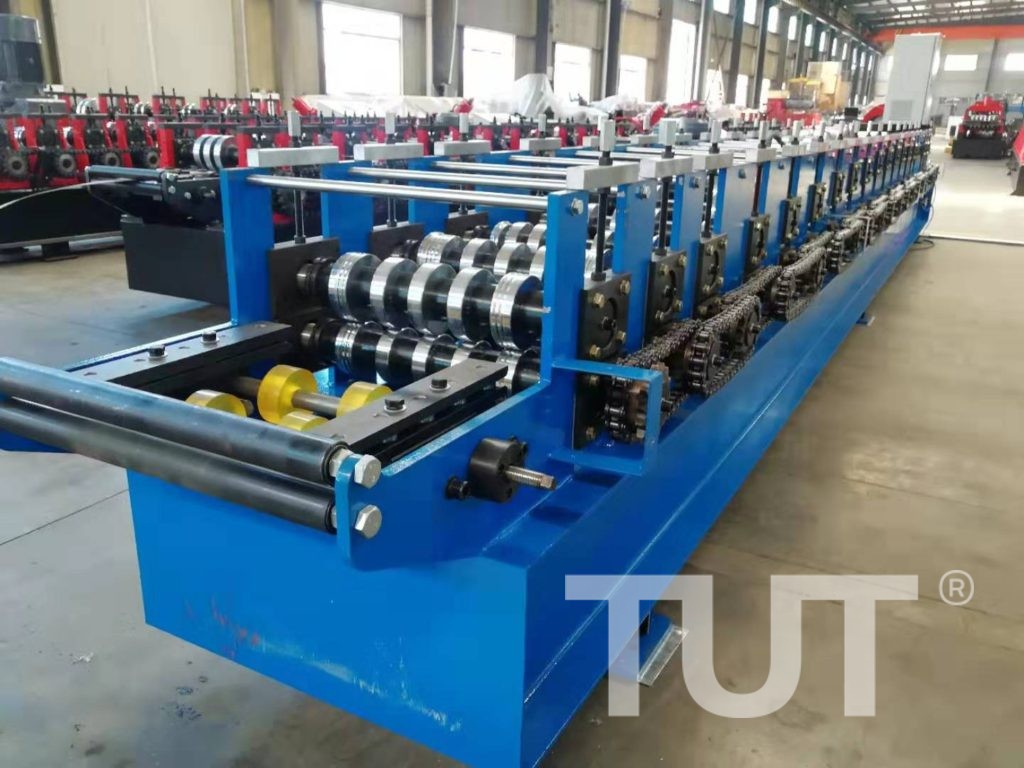
- Main roll forming machine 22 stations, φ70 mm shafts, chrome plated rolls for the lock seam.
- Seam closing section Final stations fold and lock the joint without a separate welding step.
- Hydraulic cutting device Post-cut shear with a die matched to the tube profile.
- PLC control cabinet Length and batch settings on a touch screen.
- Hydraulic station 3 kW pump unit.
- Run-out table Short roller table with a section catcher.
Optional configuration
Samples & running line
Profiles from this machine, and the line in motion
Every line is sampled before shipment. Photos below are from the build of this model; the video shows the line running on production material.
Samples are supplied as finished spouts, cut to 1 m, with the seam opened for inspection so you can check the lock quality.
Video on request
Ask for the latest running video
We record a fresh clip of this model before shipment. Ask for it and we will send the current video, plus a live call from the factory floor if you want to see the line under power.
Profile range
- Round downspout, φ80 / 100 / 120 mm
- Rectangular downspout, 60 × 80 mm to 80 × 100 mm
- Seam-locked tube with a folded joint
- Custom spout section from your drawing
Engineering & service
Custom build, installation and after-sales
A roll forming line is only finished when it runs on your material at your output. These three parts of the scope are quoted together with the machine.
Custom engineering
Downspout profiles are driven by the gutter system they connect to: the spout diameter, the seam type and the elbow radius all have to match. Send the gutter catalogue page and we will confirm the roll set, including the outlet and elbow tooling if you want to supply the complete system.
- Tooling cut to your drawing or sample
- Electrics to your plant voltage and frequency
- Layout and foundation drawing before shipment
Installation & training
An engineer supervises installation and trains your operators on the actual line — not on a generic manual. Training covers coil loading, size change, tooling change and daily maintenance.
- On-site commissioning and first production run
- Operator training on your material
- Remote video support if travel is not practical
After-sales support
A 12-month warranty on the mechanical parts, with a 24-hour response on technical enquiries. Wearing parts — rollers, punch dies, hydraulic seals — are kept in stock for fast dispatch.
- 12-month mechanical warranty
- Spare rollers and dies from stock
- 24-hour response on remote support
What we need from you
Four inputs that decide 80% of the design
- 01 Profile drawing with dimensions and tolerances
- 02 Material type, thickness range and steel grade
- 03 Target output per shift or per day
- 04 Plant voltage, frequency and available floor length
FAQ
Questions buyers ask about this machine
Answers come from real quotation discussions on this model. If your question is not here, ask it in the form below and an engineer will answer it directly.
Does the line weld or lock the seam?
It locks it. The final stations fold the strip edge into a double lock seam, which is standard for rain water goods and needs no welding, no solder and no post-finishing.
Can it produce elbows and outlets?
Not on the same roll former. Elbows and outlets are formed on a separate press tool, which we can supply with the line so you deliver the complete system rather than straight tubes.
What length can it cut?
Up to 6 m in the standard run-out configuration, limited by the table length rather than the machine.
What is the delivery time?
45–60 days after drawing approval.
Related equipment
Other machines in this range
Deck Floor Roll Forming Machine
Deck Floor Roll Forming Machine is designed to produce various types of metal decks, which is the preferred method of…
View Details
GGD Electrical Distribution Panel Roll Forming Machine
GGD Electrical Distribution Panel Roll Forming Machine is designed to produce GGD Electrical Distribution Panel which is is used for…
View Details
Corrugated Roof Sheet Roll Forming Machine
Corrugated roof sheet roll forming machines for 0.5–0.8 mm coil: 18 stations, 0–15 m/min, 15 kW main motor and hydraulic…
View DetailsRequest a quotation
Tell us the profile, we will configure the line
Send the drawing, the material and the output you need. You get a line configuration, tooling scope and delivery schedule — usually within one working day.
- Reply within one working day
- Quotation itemised by machine, tooling and options
- Engineering review of your profile before pricing