Solar Strut Channel Roll Forming Machine
Solar Strut Channel Roll Forming Machine
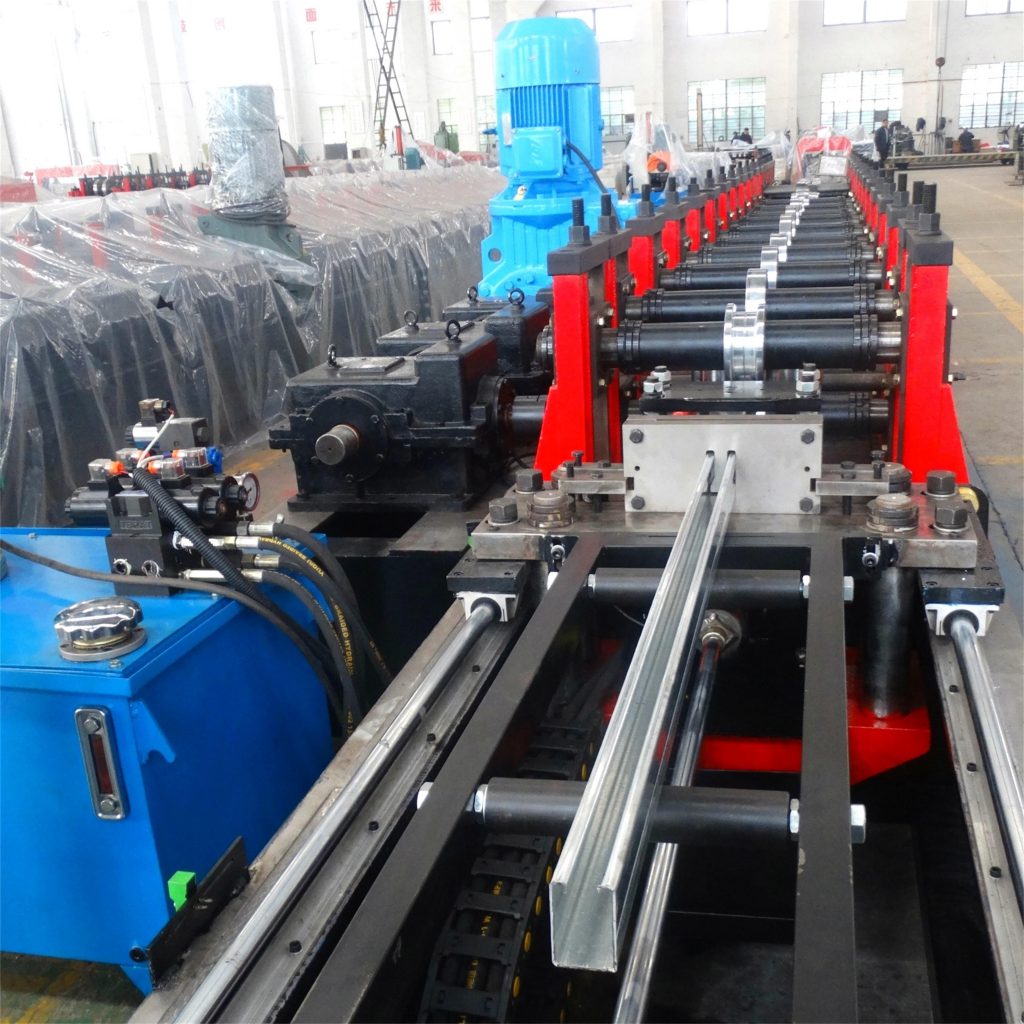
A solar strut channel line running 1.5–2.5 mm coil at up to 15 m/min, with leveler, servo feeder and press punching ahead of 22 forming stations. Produces 41 × 41 and the deeper 41 × 52 to 41 × 82 channels used in mounting structures.
- Sheet thickness 1.5–2.5 mm
- Forming stations 22
- Forming speed 0–15 m/min
- Main motor 22 kW
Applications & material
What this machine is built to produce
The same frame serves different buyers depending on the profile and the material grade. Start from the application closest to your project, then check the section sizes below.
Where it is used
- Solar mounting strut and rail for ground-mount and rooftop arrays.
- Cable support channel and seismic bracing sections.
- Plants supplying PV EPC contractors with punched, cut-to-length strut.
Suitable material
- Hot-dip galvanised steel
- 1.5–2.5 mm (2.0–3.0 mm on request)
- Zinc-aluminium coated steel
- 1.5–2.5 mm
- Prepainted steel
- 1.5–2.5 mm
- Stainless steel (special build)
- 1.5–2.0 mm
Target profiles
- 21 × 21 mm strut channel
- 41 × 21 mm strut channel
- 41 × 41 mm strut channel (standard PV rail)
- 41 × 52 / 41 × 62 / 41 × 72 / 41 × 82 mm deep channel
Not on the list? The rolls are cut to a drawing — send yours and we will confirm feasibility.
Technical data
Solar Strut Channel Roll Forming Machine specifications
Values below are for the standard build of this model. Thickness range, station count and motor rating are re-calculated when the profile or the steel grade changes.
Send your profile drawing| Parameter | Value |
|---|---|
| Sheet thickness | 1.5–2.5 mm (up to 3.0 mm on request) |
| Channel size | 21×21, 41×21, 41×41, 41×52, 41×62, 41×72, 41×82 mm |
| Forming stations | 22 |
| Forming speed | 0–15 m/min |
| Shaft diameter | φ75 mm, 40Cr |
| Roller material | GCr15 |
| Main motor | 22 kW |
| Hydraulic station power | 7.5 kW |
| Punching | Press punching via servo feeder |
| Cutting blade | Cr12MoV, HRC 56–58 |
| Control | PLC + touch screen |
Final values follow the profile drawing and material grade. Tolerance, power supply and line layout are confirmed on the approved drawing.
Working process
From coil to finished profile
The sequence below is the standard layout for this model. Stations are added or removed when the section needs more forming passes.
- 01 Decoiling Decoiler sized to your coil weight and ID.
- 02 Leveling Leveler removes coil set before the strip reaches the feeder.
- 03 Servo feeding Numerical pitch control for slot and hole spacing.
- 04 Press punching Punch press forms the slot pattern and the flange holes.
- 05 Main roll forming 22 stations form the channel, lip and return.
- 06 Cut to length Hydraulic post-cut, square to the channel axis.
- 07 Run-out table Finished strut to the bundling area.
Main components
- Main roll forming machine 22 stations, φ75 mm 40Cr shafts, GCr15 rolls.
- Leveler Five-roller leveler ahead of the feeder.
- Servo feeder Sets slot pitch numerically.
- Press punching station Press and die for slots and flange holes.
- Hydraulic cutting device Post-cut with a channel-shaped die.
- PLC control cabinet Recipes for channel size, slot pitch and length.
- Hydraulic station 7.5 kW unit.
Optional configuration
Samples & running line
Profiles from this machine, and the line in motion
Every line is sampled before shipment. Photos below are from the build of this model; the video shows the line running on production material.
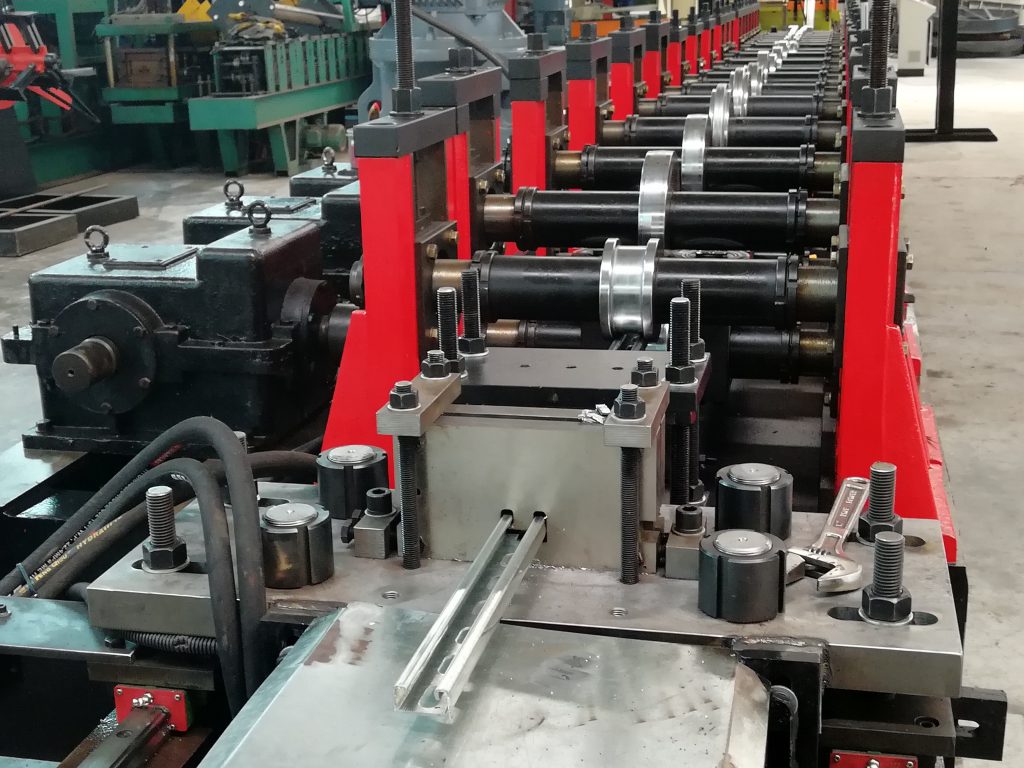
Samples are supplied in both channel depths with the slot pattern dimensioned, plus a short length for a clamp trial-fit.
Video on request
Ask for the latest running video
We record a fresh clip of this model before shipment. Ask for it and we will send the current video, plus a live call from the factory floor if you want to see the line under power.
Profile range
- 21 × 21 mm strut channel
- 41 × 21 mm strut channel
- 41 × 41 mm strut channel (standard PV rail)
- 41 × 52 / 41 × 62 / 41 × 72 / 41 × 82 mm deep channel
Engineering & service
Custom build, installation and after-sales
A roll forming line is only finished when it runs on your material at your output. These three parts of the scope are quoted together with the machine.
Custom engineering
Solar strut is priced per metre and sold in projects, so the two things that matter are slot accuracy and changeover between channel depths. We build the line with quick-change cassettes for the common 41×41 and 41×82 pair, and the slot pattern is cut to the module clamp drawing you use.
- Tooling cut to your drawing or sample
- Electrics to your plant voltage and frequency
- Layout and foundation drawing before shipment
Installation & training
An engineer supervises installation and trains your operators on the actual line — not on a generic manual. Training covers coil loading, size change, tooling change and daily maintenance.
- On-site commissioning and first production run
- Operator training on your material
- Remote video support if travel is not practical
After-sales support
A 12-month warranty on the mechanical parts, with a 24-hour response on technical enquiries. Wearing parts — rollers, punch dies, hydraulic seals — are kept in stock for fast dispatch.
- 12-month mechanical warranty
- Spare rollers and dies from stock
- 24-hour response on remote support
What we need from you
Four inputs that decide 80% of the design
- 01 Profile drawing with dimensions and tolerances
- 02 Material type, thickness range and steel grade
- 03 Target output per shift or per day
- 04 Plant voltage, frequency and available floor length
FAQ
Questions buyers ask about this machine
Answers come from real quotation discussions on this model. If your question is not here, ask it in the form below and an engineer will answer it directly.
Can one line produce 41×41 and 41×82?
Yes, with interchangeable roll cassettes. Changeover takes about 30–60 minutes with a crane; without cassettes it is a roll change of several hours, which is why most PV producers order the cassette version.
What thickness is used for solar strut?
Most PV rails are 1.5–2.5 mm galvanised steel. Heavier 3.0 mm is used where the array spans further or carries snow load, and we quote a heavier frame for that.
Is the slot pattern punched before forming?
Yes. Punching flat strip with servo pitch control keeps the slots evenly spaced; punching after forming distorts the channel and moves the slot centre.
What is the delivery time?
50–70 days after drawing and slot pattern approval.
Related equipment
Other machines in this range
Color Steel Roof Sheet Roll Forming Machine
Color steel roof sheet roll forming machine is designed with 3 groups of hydraulic punch stations, the whole roof sheet…
View Details
Laser Welding T-shaped Square Tube Roll Forming Machine for Sliding Gate Track
Laser Welding T-shaped Square Tube Roll Forming Machine is specially designed to produce sliding gate track for garage sliding gate.
View Details
Deck Floor Roll Forming Machine
Deck Floor Roll Forming Machine is designed to produce various types of metal decks, which is the preferred method of…
View DetailsRequest a quotation
Tell us the profile, we will configure the line
Send the drawing, the material and the output you need. You get a line configuration, tooling scope and delivery schedule — usually within one working day.
- Reply within one working day
- Quotation itemised by machine, tooling and options
- Engineering review of your profile before pricing