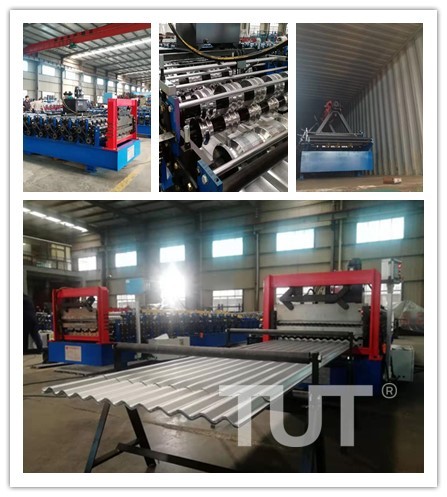
Double Layer Roof Sheet Roll Forming Machine Shipment to Brazil
Seven double layer roof sheet lines in seven containers for a Brazilian customer, forming 0.6-0.8 mm sheet from coils up to 1250 mm wide.
View projectProjects by country
Delivery records for Brazil: the machine that went there, the section it produces and the year it shipped. Open any project for the order specification, factory test run and photographs.
Seven double layer roof sheet lines in seven containers for a Brazilian customer, forming 0.6-0.8 mm sheet from coils up to 1250 mm wide.
View projectShipping and installation
Ports, transit time and electrical standard are the three things that change from country to country. The machine itself is built to your section drawing wherever it ships.
Brazil builds a large share of its roofing and cladding on double layer roll forming lines, because one machine covers two profiles and saves floor space in a plant that produces both trapezoidal and corrugated sheet. TUT Machinery delivered seven double layer roof sheet lines to a customer in Brazil in January 2020, shipped in seven 40ft containers. The lines form 0.6 to 0.8 mm prepainted or galvanized sheet from coils up to 1250 mm wide, and each set was test run in our factory before packing.
Sea freight to Brazil is typically to the port of Santos, with transit of 4 to 6 weeks from Wuxi. Brazilian plants run on 380 V, 60 Hz, three-phase, so the drive, inverter and control panel are configured for 60 Hz rather than the 50 Hz used in most of Asia and Europe — this is confirmed at order stage and verified during the factory test run. Our engineers can travel to Brazil for installation, commissioning and operator training, and the container packing plan is prepared so each line arrives as a complete, traceable set.
Questions
A double layer line produces two profiles — typically trapezoidal and corrugated — on one frame with one drive and one control system. It costs less than two separate lines, takes roughly half the floor space, and needs one operator instead of two. This is why the customer in Brazil took seven double layer lines rather than fourteen single machines.
The motors, inverter and control panel are configured for 380 V, 60 Hz, three-phase, which is the standard industrial supply in Brazil. Because 60 Hz changes motor speed for a given drive setting, we set the line speed and verify it during the factory test run rather than on site, so the machine arrives producing at the specified metres per minute.
The lines delivered to Brazil form 0.6 to 0.8 mm sheet from coils up to 1250 mm wide, which covers the common prepainted and galvanized roofing gauges used in Brazilian construction. If your product range includes thicker material or wider coils, we size the shaft, drive and uncoiler accordingly.
Next step
Send the section drawing, material and thickness, the output you need per shift and the destination port. You will get a line configuration, tooling scope, packing plan and delivery schedule — usually within one working day.